

Residue of Man
The leavings of intimacy
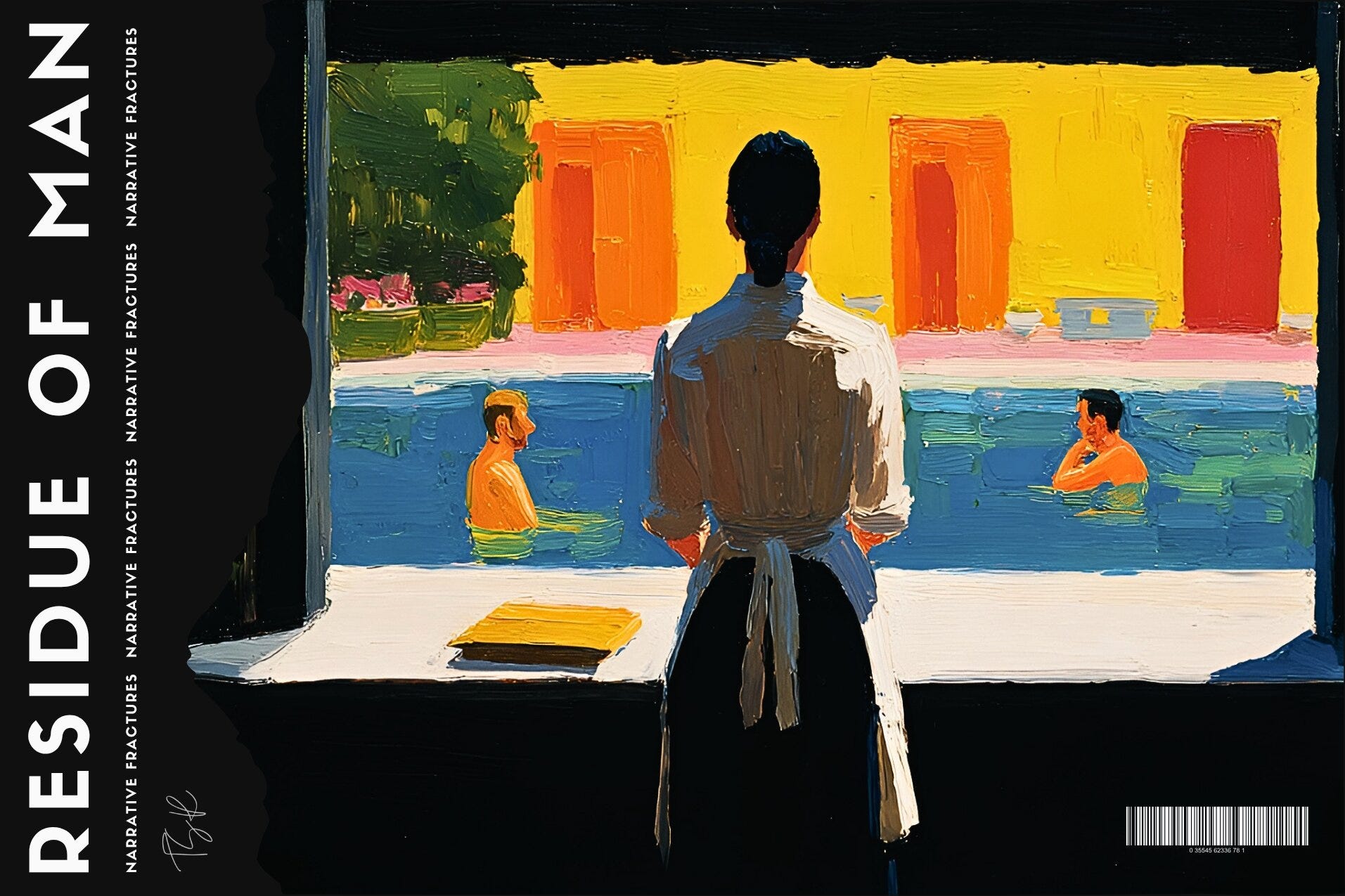
A story by A. Anton
Luisa had worked the upper corridor of the Hotel Salvaje for nine years and had learned, in that time, how to read a room. Not so much what people left behind, that much was easy enough to parse, but what the rooms held when she opened them in the mornings.
The particular residue of a night.
She wasn’t sentimental about this. It was simply information, and she had become good at receiving it.
Room nineteen smelled, on the first morning, of a cologne she didn’t recognise and spent some time trying to place. Bergamot, and underneath it something sweeter, something that had no name she could find in the names she had catalogued over forty-six years of life.
The bed had been slept in diagonally, one pillow on the floor, the sheets roped into themselves at the bottom as though time had been in need of a shape to abandon.
The window was open to its limit. On the desk was a paperback, left face-down with the spine cracked back hard, and a glass with a watermark at the bottom. There was a faint print on its side where fingers had held on.
She straightened the book from habit.
Room fourteen was different. The bed was made, but clearly by someone who knew the correct way to go about things and had chosen this morning to leave routine one step shy of complete.
There was a cream towel in the bathroom, thicker than the hotel towels, and two leather shoes at the foot of the bed, placed parallel with an exactness that sat oddly against the half-made sheets. On the nightstand was a glass of water, still full.
There was also a book with a receipt inside it marking the place, and beside the book, pressed flat, a photograph she did not look at directly. She turned it over with the corner of her cloth and let it lie.
She would have said, if asked, that the man in room fourteen was a person who applied himself to the management of things and found in this some form of relief. She was right about this and wrong about what it cost him.
She saw them together for the first time on Friday morning from the corridor window overlooking the pool, a long blue rectangle, and beyond it the sea going on.
The one from room nineteen, greeted once in passing, was coming out of the water, or had just come out. He was standing at the pool’s edge, letting the water run off him, unhurried, his head bent forward as drops moved from his hair down the swell of his mouth.
The one from room fourteen, seen sometimes leaning idly against the corridor wall, lay on a sun lounger with a book in his hands. He was not reading.
She could tell, from years of watching people arrange themselves around books, the particular quality of eyes moving across a page—and the particular quality of eyes that are not—and his were not; they were at the approximate level of a paragraph, and somewhere beyond words.
The one from the water walked to a chair, picked up a towel, and worked it through his dark hair without looking at the other one. With, she thought, quite a lot of effort, not looking at the other one.
She watched the man with the book turn a page.
Their names she knew from the bookings, overheard in passing. Sebastián, from room nineteen. Callum, from fourteen. She thought of Sebastián first and most easily because he was the kind of person rooms remembered differently: something residual in the air she entered each morning that was not unpleasant and not entirely neutral.
Callum’s room gave less away, which, as she had learned over nine years, was itself a form of information.
On Friday evening, she was finishing up on the far end of the corridor when she heard the stairwell door swing open and voices in it, low, already mid-breath. She did not intend to hear. The acoustics in that corridor were a longstanding problem.
Sebastián’s deep voice came first, something she didn’t catch fully, the shape of it more than the content, and already taking up all the space inside her.
Then came Callum’s gasp. “You’re doing it on purpose.”
And a silence in which she could hear the air turn over.
“Of course,” Sebastián murmured.
A door clicked open. She heard the sound Callum made before it closed, not quite a laugh and not quite its opposite, and then the corridor was ordinary again, and she stood with her hands on the cart, warm palms against the metal, with the drag of the sea coming through the open window at the far end.
On Saturday morning, Luisa was collecting linens from the cupboard near the bar terrace when she heard Sebastián’s voice at a distinctly social register, warm and unhurried.
She looked around the corner, and there he was with a French couple who had arrived earlier that morning. The woman was lovely and knew it, and her partner was handsome in the way of men who have been told so once and are still deciding what to do with the information.
Sebastián stood close to the woman, but it seemed that he had arrived at the exact distance at which his closeness spoke more of detachment. When she laughed, she leaned towards him, one ruby-nailed hand sweeping up her bare thigh as the other came briefly to the wiry hair on his forearm.
He let it rest there before she withdrew it, and he was talking the whole time, his handsome face open and warm, a face that had in it none of the guardedness Luisa had seen in glimpses from the corridor window.
Then, she noticed Callum at a terrace table.
He had a half-drunk coffee that must have been there long enough to turn oily, and he was not drinking it.
He was looking at Sebastián. More precisely, he was looking at the place on Sebastián’s arm where the woman’s hand had been, and was near enough to skim once more, and his own hands were around his coffee cup with a stillness that was not at all comfortable to observe.
His face was level, and Luisa had the feeling, watching him, of standing near something that was generating a great deal of heat.
Sebastián turned. He would have had to exert some effort not to see Callum across the terrace, and he was clearly not in the mood for labour. He looked at the light-haired man with a directness that did not acknowledge the French couple or the afternoon heat or anything else in the world, only whatever was moving between them.
His chin lifted. A degree, perhaps less.
Callum looked at him for a moment and then looked at his coffee, drank it cold, and set it down. Sebastián turned back to the French couple. His hand went briefly to the woman’s shoulder, bare and soft-looking.
He said something that made her laugh again, and the laugh was real, Luisa could tell a real laugh, and when she glanced back at Callum’s table, his hands were flat on the surface on either side of the cup, long fingers pressing down on it slightly, as though the table needed steadying or the cup overturning.
She heard them through the wall that afternoon.
Room fourteen shared plumbing with room fifteen, and both the pipes and the thin plaster between them had always been porous to sound in ways she had learned not to be startled by.
She was changing the towels in room fifteen when she heard them.
Callum’s voice came through first, a sound she needed a moment to process as coming from him, as belonging to that level face and those careful shoes and the untouched glass of water on the nightstand. It came at a register unaware of being heard, just the body’s own cry about what was being done to it.
Then Sebastián's voice, very low, almost nothing. Luisa stood unmoving, the wall between them thin enough to carry everything.
A sound came through it, distinct and involuntary, abandoned on its way to being a word, and she stood in room fifteen with a towel against her chest and heat moving up through her and the sea through the window going on, enormous, indifferent, and the shivery sounds from the other side of the wall human and small and not small, the sounds of two bodies past pretending, and then Sebastián’s voice again saying something she caught only in part, twice, and the way he said it both times was the way you rip a thing out of yourself that you have been trying not to name.
She left before it was finished. She sat in the linen cupboard at the end of the corridor and folded a towel and unfolded it and pressed her palms flat on her thighs, squeezed against the pulse between them, and waited for her body to settle into something she could carry. It took some time.
Monday morning, room nineteen.
The cologne settled inside her before she had the door fully open. She had developed, over the past few days, a relationship with this smell that she could not have described to anyone.
The sheets were a damp heap. Both pillows on the floor this time, and the bedside glass empty, and on the rail a towel that was thicker than the hotel’s, a creamier white, which she understood to mean that the man from room fourteen had come here with the expectation of showering, which meant a further sequence of information she dealt with by straightening the towel and moving on.
On the desk, she found a receipt from a bar in town, placed beside the hotel pen. She did not read it. And beside the bin was a shirt, good linen, dropped rather than placed, and on the collar of it was the absence of a button, just a small intact circle of thread.
In room fourteen, the bed was made more correctly than any previous morning, almost entirely correctly, the sheets pulled and untucked just enough to seem like the bed had been slept in.
On the nightstand, the glass of water was full and untouched again, and beside it the photograph that she had noticed on the first morning stood upright, propped against the lamp, and she looked at it this time without intending to.
Two young boys on a seafront she didn't recognise, though she had grown familiar with the men they would become.
The lighter-haired one was laughing with his whole body, his shoulder pressed into the other’s. The other one was looking at the laughing one with the expression of someone taking in something they believed they could not survive. Neither of them yet sixteen, at a guess. The photograph was worn at the edges.
Luisa replaced the glass of water with a fresh one and left the photograph where it stood.
She closed the door behind her and stood a moment in the corridor with the sea moving in the window at the far end of the corridor and the smell of Sebastián’s cologne on her hands from when she’d handled the sheets, bergamot and underneath it that sweeter thing, the thing she had never managed to name or stop anticipating, and she breathed it in and then pushed the cart forward and went on.
On Tuesday afternoon, she saw them at the pool again from the corridor window. They were both in the water. Sebastián was saying something, lips at Callum’s ear, one arm along the pool’s edge past Callum’s shoulder so that his body bracketed the other’s strain.
Callum had his head slightly turned away, his jaw set against the gooseflesh down the column of his neck, eyes fixed in the middle distance, and stomach heaving with the chest’s ebb. Luisa understood the moment without having to look below the water’s surface.
The French woman came to the edge of the pool then. She said something to Sebastián, her hand shading her eyes, her long hair reaching past the hips angled towards the man’s mouth.
Sebastián’s face opened into warmth the way it so often did, the way it always seemed ready to do, effortless and genuine. They spoke for a moment, and she laughed, and all the while Sebastián’s other hand was moving in the water by Callum’s hip.
Whatever it was doing underwater, Luisa couldn’t see, only that Callum’s throat moved, a single swallow, and the hand resting on the pool’s rim went white at the knuckles and then released.
When the French woman left, Sebastián looked at Callum with a look that was not at all like the one he had given her. Callum looked back at him with an expression that was close to pain but beyond it somehow, in the territory pain eventually reaches when it has become the weather.
Then Callum said something, but he must have said it quietly because Sebastián leaned in as if to hear him better.
After a moment, the dark-haired man pressed closer still, and his hand slid up the back of Callum’s neck, fingers tangled in the ends of his hair, and Callum’s eyes fluttered once and didn’t open again for some time.
The French woman settled onto a sun lounger with a book. A couple near the deep end were laughing about something. The sea went on behind everything, big and blue and entirely lost to the specifics of human need.
Luisa stood at the window with her cart and her clean towels, nine years of professional distance holding her still, watching the hand beneath the water that she could not see, and she stayed a moment past when she should have left, and then made herself leave.
They checked out on Wednesday. She did room nineteen last and was not honest with herself about why.
The cologne hit her at the door. She stood in it a moment before entering, her hand still on the frame. The bed was left in its usual state, with pillows scattered across the mattress and sheets piled at the foot of it.
The desk was clear except for the hotel pen and an empty glass with two handprints on it, eight fingers and two thumbs, which she looked at for a moment before moving on.
In the bathroom was his cologne. She picked up the overlooked bottle and held it, and then quickly sprayed some on her cuff and put it back.
She opened the window to its limit, as he had always had it, and stood in the moving air from the garden, the lemon trees below, the amber glow, and the smell of bergamot and the sweetness coming off the sheets and walls, where nine years of attention had taught her rooms hold what they are given and give it back whether you want it or not.
In her pocket was the shirt button, warm from days of being carried around. She took it out and held it and then placed it on the desk beside the hotel pen, for no reason she could name.
Once the room had been cleaned, she took hold of the cart and closed the door, and went down the corridor towards the window and the sea in it, past the reach of any of it, past all their heat and hunger and the poor thin walls of the rooms that held them, enormous and unmoved.
She stood for a moment at the window.
The warm air from the garden moved up the corridor, carrying the faint zest of the lemon trees, and under it still the trace of the cologne on her hands and sleeve.
For a moment, without intending to, she remembered another smell, from another time, the sweetness of a room with the shutters closed against the morning light, the two of them staying in bed long past the hour when people rose and ate, her nightdress twisted off her soft belly and legs.
She remembered finding the place where her husband’s taste had come and dried again, the sense then that the body could go on like that without end, that whatever lay beyond the shutters belonged to someone else.
It had not lasted. Nothing like that ever did, she told herself. It grew and stretched and fought its own shape.
She rested her hands on the cart until the warmth in her settled. The sea moved in the window, blue and wide and entirely without memory, and she breathed once, deeply, and pushed the cart forward.