

In Passing: Mar–May 2026 Releases
Reading the literary horizon
A curated look at some compelling works arriving between March and May 2026.
Nature Poems to See By | Julian Peters
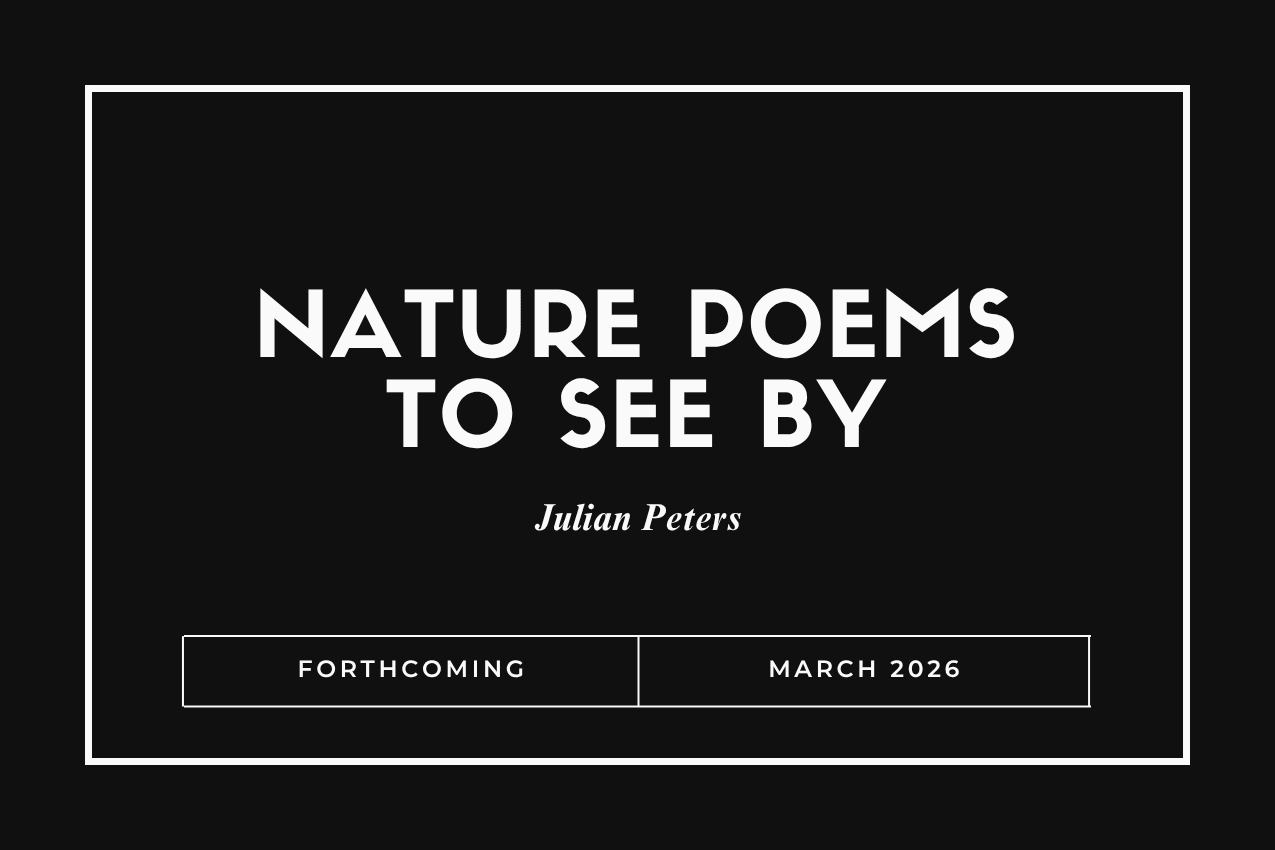
In Nature Poems to See By, Peters transmutes the musicality of language into visual resonance, drawing poem and image together in a way that furrows the fabric of interpretation. The illustrations themselves act as interpretive renderings of the verses, stimulating both the mind and senses.
Many traditional poems reappear in a modern context, where humanity battles and suppresses the beauty of life’s origin in an ode to nature freed from Man’s unfeeling touch.
And yet, the visuals add a deeply human component often absent in text alone. For example, we come across a blackbird singing bright and true, its belly swelling beneath the eyes of resting World War I soldiers—figures absent from Edward Thomas’ Adlestrop, though invoking the war waiting just beyond the poem’s stillness.
Peters also captures shades of green with a sharpness that peels back nature’s layers, inviting a reckoning with the art of recreation.
Across the collection, the medium is constantly at play: hand-drawn illustrations, curated magazine cutouts, and photographs with flecks of colored shapes born of a playful, inventive mind.
But not all is fair and quiet. Human forms bristle as they slide into their animalistic, “earth-born companions,” unsettling the boundary between what humans imagine as the divine and the divinely forgotten.
Rhina P. Espaillat’s Butchering receives an especially haunting treatment, with teary paintings livening the tensions between subject and object—and the shared nature of sentiment.
As a whole, the collection is a visual feast, experimental in format and rich in expressive possibility.
Most importantly, Peters’ imagery develops as parallel poems in their own right—destabilizing and new—leaving us caught fully between seeing and feeling, someplace between words and shades, and forever between the wild and the human.
An advance copy was provided by Plough Publishing House.
Genres
Comics, Graphic Novels, Manga | Poetry & Verse
Publication Date
March 24, 2026
What We Are Seeking | Cameron Reed
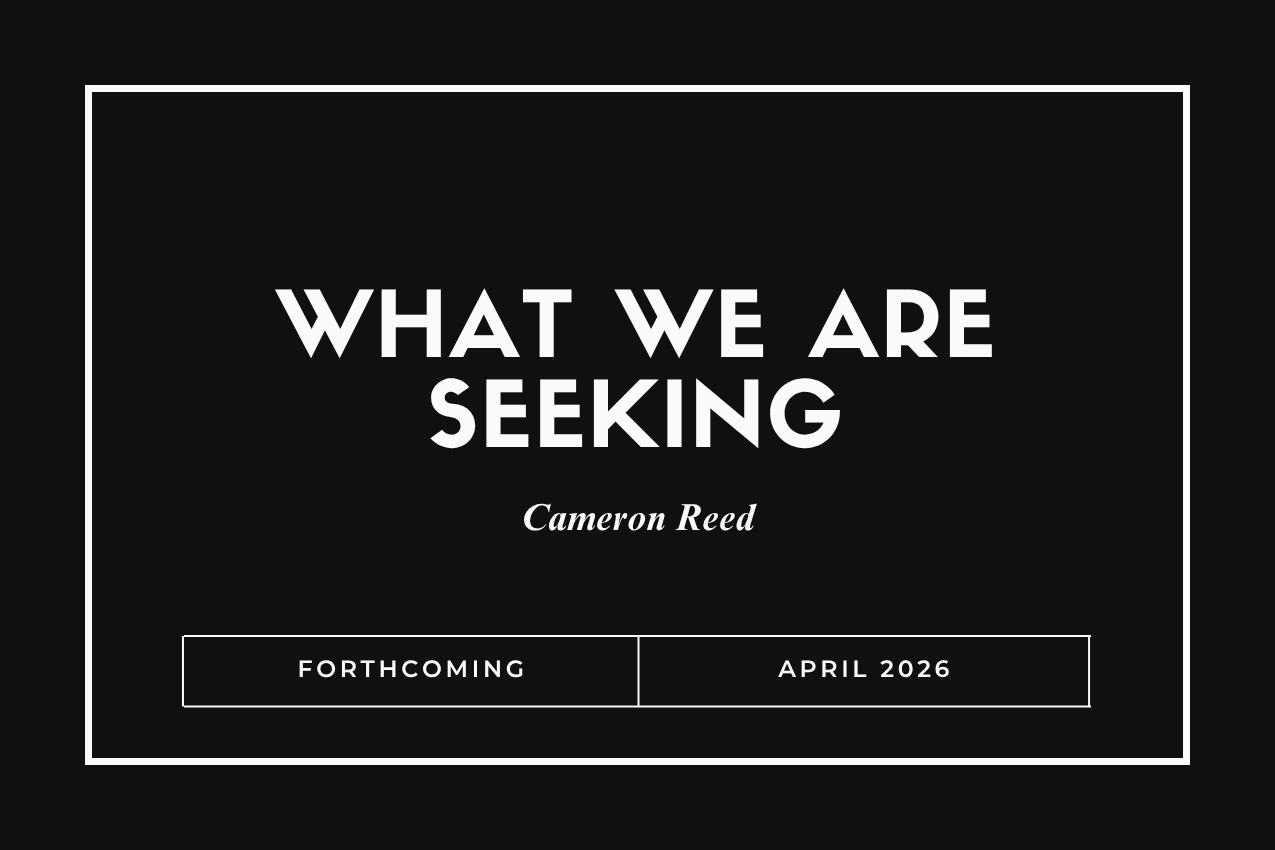
What We Are Seeking is a conceptually ambitious work that opens onto a landscape of impossible forms—from sense-defying entities to a self-compressing ship—and evokes an awe that firmly resists articulation.
The story follows John Maraintha, a medic sent to Scythia, a planet where nature obeys unfamiliar laws and survival is anything but temperate.
In this desert world—where the boundaries between the natural and the monstrous feel disturbingly thin—human customs can prove just as unforgiving as the landscape itself.
From the start, the worldbuilding feels rich and carefully imagined, particularly in its treatment of language, gender, and social custom, as well as the interweaving of nature with self-imposed constraints such as marriage, monogamy, or diet.
Through this lens, the novel invites a reconsideration of how life is organized and perceived. It privileges thought and interpretation, asking us to loosen familiar mental structures and reflect on how reality is informed by language, custom, and experience.
Reed’s writing also makes space for itself, allowing complexity to remain intact and letting moments of wonder settle rather than steering them toward a single conclusion.
Over time, though, this approach makes the reading experience somewhat difficult to sustain. The narrative devotes considerable attention to explanation and groundwork, with relatively little forward momentum through character or event.
Most notably, the protagonist remains largely peripheral, both to the world he enters and to his own inner life.
Because of this distance, even moments of physical intimacy are filtered through a detached, clinical perspective, registering entirely as functional rather than sensorial or emotional. While a low-action structure can be effective, it’s easy to find oneself missing an emotional point of contact.
In the end, the framework is strong and compelling, but the relationship between concept and embodiment may feel too restrained for some.
Readers drawn to speculative fiction or science fiction that prioritizes perception, social design, and intellectual exploration over plot or emotional immediacy will likely find What We Are Seeking highly rewarding.
An advance copy was provided by Tor Books.
Genres
Sci-Fi & Fantasy | LGBTQ+
Publication Date
April 7, 2026
Everything Dead & Dying | Tate Brombal
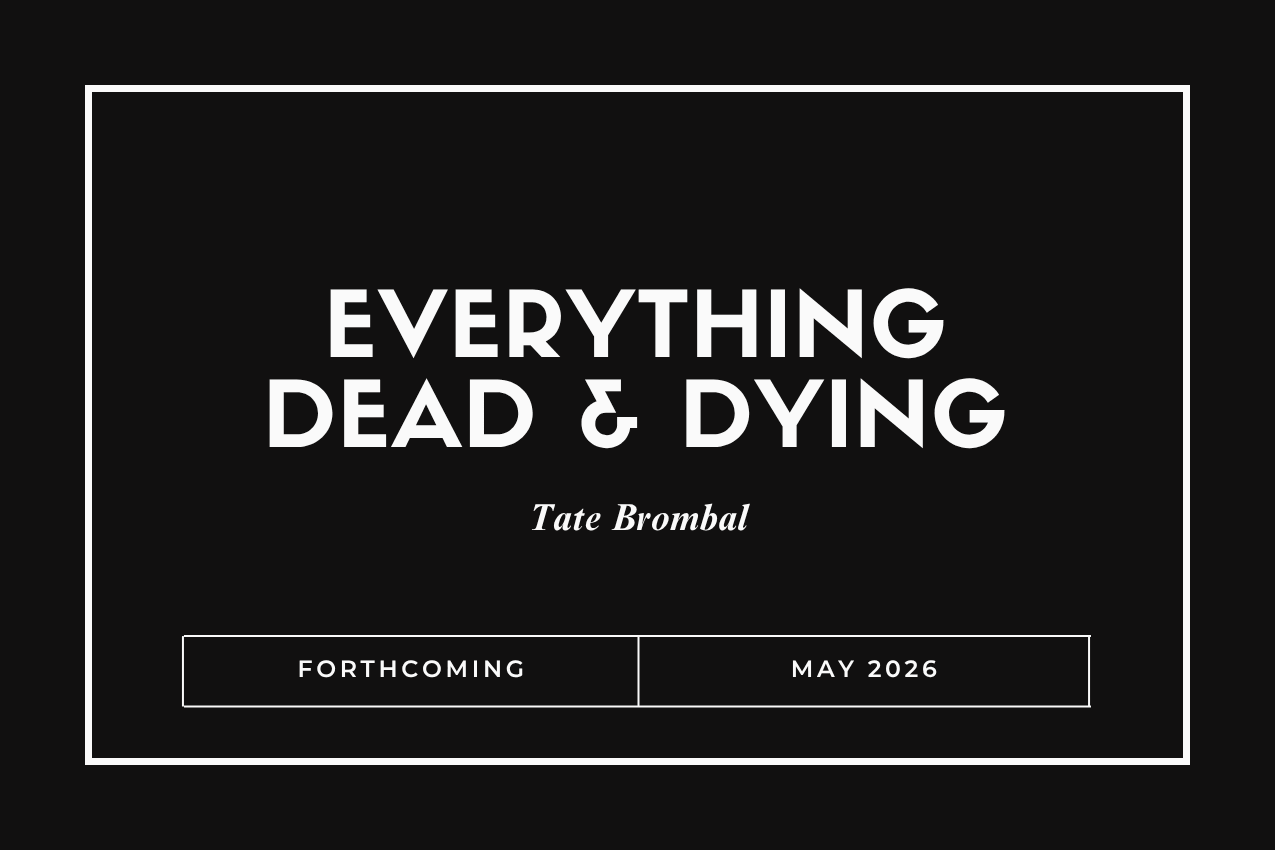
As a seemingly lone survivor of a zombie apocalypse, Jack Chandler has chosen to preserve a facsimile of life in his town. He’s found that, through routine feedings, he’s able to keep the monstrous instincts of his fetid community at bay, including those of the husband and adopted daughter he once fought his own demons to keep.
But when outsiders eventually discover the town, Jack becomes the final barrier between his family and those determined to rid the world of the liminal.
Right away, Brombal’s narrative settles into a muted visual register, animated by Jacob Phillips’ artwork and Pip Martin’s color design. Shades appear heavily desaturated, with shadows blurring the edges between backdrop and flesh to wring the atmosphere into a state of bated unrest.
While the past surfaces in brighter tints, the present carries blighted tones marked by time and decay. The movement between them feels almost pendular, with memory slipping through the present to reveal the strain working its way from within each character.
All the while, different hells push to gather in the same space: grief, memory, loss, violence, and the slow persistence of the undead.
As these layers thicken, the emotional tension of the story comes into keener focus. Devotion, commitment, and fatherhood move doggedly through the narrative, shaping a world where the boundary between the human and the inhuman no longer holds steady.
Even when the imagery turns gory, the narrative’s tissue feels mostly woven from suggestion, allowing the deeper questions of care, purpose, and attachment to bear the weight of our expectations.
Ultimately, Everything Dead & Dying settles into something more intimate than survival-based, with its vision of life shaped by the fragile realities our emotions learn—often tragically—to press into the world.
An advance copy was provided by Image Comics.
Genres
Comics, Graphic Novels, Manga | Horror | LGBTQ+
Publication Date
May 5, 2026 (Collects all issues, #1–5)
Sixty Stories | Donald Barthelme
In Sixty Stories (first published in 1981), Barthelme tests the limits of perception, probing that strange space where the surreal and the absurd come together. There, identity twists through language, reality bends under bureaucratic logic, and the everyday quietly shapeshifts into something both comic and disturbing.
There’s a distinct tension present from the start of the short story collection that reveals something central to Barthelme’s play with form: the surreal and the absurd—understood in a distinctly Kafkaesque sense—continually refract each other.
As we quickly learn, in Barthelme’s hands, bureaucracy consistently overwrites experience, and the result stabs at the skin’s solace.
Perhaps no story captures this more headily than Me and Miss Mandible, which echoes many a nightmare and remains provocative even now.
Here, a thirty-five-year-old veteran and insurance adjuster finds himself attending school alongside eleven-year-olds who are—technically—his peers, all while being lusted after by his teacher. The absurd logic of his circumstances is laid out in the first paragraph:
“Miss Mandible wants to make love to me but she hesitates because I am officially a child; I am, according to records, according to the card index in the principal’s office, eleven years old.”
Interestingly, across the collection, life’s surreal deviations are rarely framed as forces to reckon with. Instead, they resemble small betrayals that are ultimately nothing more than quietly accepted conditions of living. This, in turn, leads us to the absurdity of aching for coherence.
And while Barthelme’s self-assured humor is delightful, his stories rarely remain content with surface-level playfulness. His surrealism is often pushed far enough that the illicit thrill of bending reality begins to flatten; once no rules apply, the tension shifts.
As a result, what initially reads as droll unease quickly steels itself into something closer to hurt: an awareness that the signs we’re taught to read as the truth—the paths laid out for us in school and childhood—may have been unsteady and meaningless all along.
Language itself becomes one of Barthelme’s most restless instruments. In For I’m the Boy, syntax loosens, with quotation marks—and at times, the usual punctuation—slipping off the page as the prose dips toward something like stream of consciousness.
Will You Tell Me? moves in a parallel direction, stripping the prose to its rudimentary form with little connective flow between sentences:
“(...) Paul regarded Hilda thoughtfully. You love Inge, she said. He touched her hand. Rosemarie returned. Paul grew older.”
The result leaves us scrambling. Lives accumulate in fragments—scene upon scene stacked and trimmed—demanding a peculiar intensity of attention. One begins to wonder how much emotional force the most denuded of sentences can carry, and how the placement of letters alone dictates mood and understanding.
In a sense, many of Barthelme’s linguistic experiments circle a similar disturbance: a mislocation of the self. Identity seems to glide around the very structures meant to solidify and restrain it.
Game, for example, homes in on the absurd logic of military obligation while quietly destabilizing the narrator’s grasp on reality, echoing Joseph Heller’s Catch-22 (1961) to fine effect:
“Shotwell is not himself, but I do not know it (...).”
If Sixty Stories sometimes pushes its surreal gestures so far that their pressure dissipates, the collection nonetheless remains fascinating for the risks it takes with form and language.
Importantly, Barthelme’s stories repeatedly test how far narrative can stretch before coherence gives way—revealing, in the process, how easily the systems meant to hold experience expose their emptiness.
An advance copy was provided by Picador.
Genre
General Fiction (Adult)
Publication Date
May 26, 2026